
Distinguishing patients who need medical treatment and observation from those requiring targeted respiratory support or urgent escalation.
Clinical bottom line
- Breathlessness alone is not an indication for NIV. Routine NIV is not recommended in otherwise uncomplicated normocapnic, non-acidotic COPD exacerbations. (Indian Journal of Critical Care Medicine )
- Normal pH does not exclude hypercapnic respiratory failure. Elevated PaCO₂ with normal pH may represent chronic compensated hypercapnia.
- Normal PaCO₂ does not exclude a need for respiratory support. Persistent hypoxaemia, objective respiratory muscle fatigue or another diagnosis may justify escalation.
- The strongest COPD-specific indication for NIV remains acute hypercapnic respiratory acidosis. Its established mortality benefit should not be extrapolated to patients without this physiological disturbance. (Cochrane )
What does “without hypercapnic respiratory failure” actually mean?
It means that the patient does not have hypercapnic respiratory failure—not simply that the pH is normal.
Two clinically different groups are often combined:
Normocapnic exacerbation: PaCO₂ is not elevated. The patient may nevertheless have substantial breathlessness, increased work of breathing or hypoxaemic respiratory failure.
Non-acidotic hypercapnic exacerbation: PaCO₂ is elevated but pH remains ≥7.35. This may reflect chronic compensation. Previous blood gases and bicarbonate help establish the context; these patients should not be classified as having no hypercapnic respiratory failure merely because their pH is normal.
This distinction matters when interpreting evidence. A study enrolling patients with normal pH cannot automatically answer whether NIV helps patients with normal PaCO₂.
Does NIV improve outcomes in genuinely normocapnic exacerbations?
A clinically important benefit from routine NIV has not been established.
The strongest evidence concerns acute hypercapnic respiratory failure with respiratory acidosis. The Cochrane review included trials whose populations had mean admission pH below 7.35 and PaCO₂ above 45 mmHg. Its reductions in mortality and intubation cannot therefore be assumed to apply to patients with normal blood gases. (Cochrane )
Evidence from milder exacerbations is less convincing. Keenan and colleagues found some early improvement in dyspnoea, but poor treatment completion and no demonstrated improvement in major clinical outcomes. The study was small and did not exclusively enrol normocapnic patients. (Sage Journals )
The appropriate conclusion is “insufficient evidence for routine use”, rather than “NIV can never help”. The practical task is to identify a genuine respiratory-support indication instead of using NIV simply because a patient with COPD is breathless.
What about patients who retain CO₂ but are not acidotic?
Do not start acute NIV solely because PaCO₂ is elevated in an otherwise stable, non-acidotic patient. ERS/ATS conditionally recommends against routine NIV in this setting. (American Thoracic Society )
Selected patients may benefit, but the evidence does not reliably identify who should receive treatment. In the small Pastaka trial, NIV shortened hospital stay in patients with chronic hypercapnic respiratory failure and pH ≥7.35. That finding does not establish benefit in patients without hypercapnia. (PubMed )
A useful clinical distinction is between an abnormal CO₂ value and a deteriorating patient. Stable compensated hypercapnia generally calls for treatment of the exacerbation and reassessment; increasing distress or worsening blood gases requires renewed evaluation. (Indian Journal of Critical Care Medicine )
Can severe work of breathing justify NIV before hypercapnia appears?
Potentially—but this is selective treatment for threatened respiratory failure, not routine treatment of breathlessness.
GOLD includes severe dyspnoea accompanied by signs of respiratory muscle fatigue or increased effort among NIV indications. Examples include accessory muscle use, paradoxical abdominal movement and intercostal recession.
Practical interpretation: Persistent objective distress despite initial treatment warrants urgent respiratory or critical-care assessment. A monitored NIV trial may be reasonable when respiratory support is judged necessary and immediate intubation is not required. Similar individualised considerations appear in the ERS guidance on hypoxaemic respiratory failure. (ResearchGate )
This should not become an automatic rule that every tachypnoeic patient receives NIV. Document the reason for treatment, the intended response and the escalation plan. There is no well-validated protocol for routinely starting NIV in normocapnic COPD exacerbations before respiratory acidosis develops.
What should be done before considering NIV?
Treat the exacerbation, assess its severity and identify competing causes of deterioration.
Initial management includes short-acting bronchodilators, systemic corticosteroids when indicated, and antibiotics according to the clinical indication. Assess blood gases and obtain appropriate chest imaging; associated conditions must be identified rather than attributing all deterioration to COPD.
When respiratory failure is suspected or ventilatory support is being considered, blood-gas assessment is important: pulse oximetry alone cannot assess PaCO₂ or acid–base status. (ResearchGate )
For patients at risk of hypercapnic respiratory failure, initially target SpO₂ 88–92% pending blood gases. BTS permits a target of 94–98% after normal pH and PaCO₂ are confirmed in selected patients without previous hypercapnic respiratory failure requiring ventilation or a usual stable saturation below 94%. Repeat gases after 30–60 minutes, even when initial PaCO₂ is normal, and sooner if the patient deteriorates.
What if hypoxaemia—not hypercapnia—is the main problem?
Use a cause-specific approach to hypoxaemic respiratory failure rather than automatically applying the acidotic COPD NIV pathway.
Acute cardiogenic pulmonary oedema is an important exception: CPAP or bilevel NIV may be appropriate without hypercapnia. This is treatment for pulmonary oedema, not evidence supporting routine NIV in normocapnic COPD. The ERS/ATS recommendation does not extend to cardiogenic shock. (American Thoracic Society )
For acute hypoxaemic respiratory failure more generally, ERS conditionally favours high-flow nasal cannula oxygen therapy—HFNC—over conventional oxygen and over NIV. The recommendation requires clinical judgement and does not mean that every patient adequately supported with conventional oxygen needs HFNC. (ResearchGate )
GOLD 2026 similarly places high-flow therapy first for acute hypoxaemic respiratory failure, with NIV considered for hypercapnic respiratory failure or failure to respond to high-flow therapy. Deterioration despite non-invasive support requires prompt reassessment rather than repeated device changes that delay necessary intubation.
Is HFNC an evidence-based replacement for NIV in every non-acidotic exacerbation?
No. The device should match the respiratory problem; neither HFNC nor NIV is the default treatment for a normal-pH COPD exacerbation.
In Xia and colleagues’ trial of non-acidotic, mildly hypercapnic exacerbations, HFNC did not reduce the primary outcome of meeting intubation criteria compared with conventional oxygen. Median hospital stay was longer—nine versus eight days—and the low event rate limited the trial’s statistical power. (Springer )
This does not exclude benefit in selected subgroups. It does, however, argue against treating “normal pH” as an automatic indication for an advanced respiratory-support device.
When does the conventional COPD indication for NIV appear?
When hypercapnia is accompanied by persistent or developing respiratory acidosis despite initial treatment.
BTS/ICS recommends NIV when pH <7.35 and PaCO₂ >6.5 kPa persist or develop despite optimal medical treatment. (ResearchGate )
ERS/ATS uses pH ≤7.35, PaCO₂ >45 mmHg—approximately 6.0 kPa—and respiratory rate >20–24 breaths/min despite standard treatment. These criteria should not be silently merged into a single supposedly universal threshold. (American Thoracic Society )
Neither recommendation means waiting for acidosis in a patient who is already failing clinically. Respiratory arrest, an immediate airway threat or rapidly worsening respiratory failure requires urgent escalation. (ResearchGate )
How should a selected NIV trial be monitored—and when should it stop?
Use a time-limited therapeutic trial with an explicit escalation plan.
Deliver NIV in an appropriately staffed area and document the indication, treatment ceiling and expected response. Monitor respiratory effort, consciousness, oxygenation, tolerance and blood gases. BTS quality standards support blood-gas reassessment at approximately one hour, with assessment required within two hours; failure to improve should trigger urgent specialist review. Clinical deterioration requires immediate reassessment. (British Thoracic Society )
These standards were principally developed for acute hypercapnic respiratory failure. In an initially normocapnic patient, success cannot be defined simply by a higher pH: the problem that prompted support—such as excessive respiratory effort or inadequate oxygenation—must improve.
Practical interpretation: Once that indication resolves, reassess whether NIV is still necessary. If the patient worsens, do not continue treatment merely because the mask is tolerated or the oxygen saturation looks better.
Bedside interpretation
| Presentation | Clinical interpretation | Practical approach |
|---|---|---|
| Normal PaCO₂ and pH; improving after treatment | No established hypercapnic respiratory failure | Medical treatment and observation; no routine NIV. |
| Elevated PaCO₂ with normal pH | Possible compensated hypercapnia | Compare previous gases and reassess the clinical trajectory. |
| Hypercapnia with respiratory acidosis | Established COPD NIV population | Use the acute NIV pathway unless immediate intubation is required. |
| Normal PaCO₂ with persistent hypoxaemia or objective fatigue | A different or evolving respiratory failure problem | Identify the cause and obtain specialist assessment. |
This table synthesises the guideline distinctions; it does not introduce additional treatment thresholds. (Indian Journal of Critical Care Medicine )
Clinical algorithm
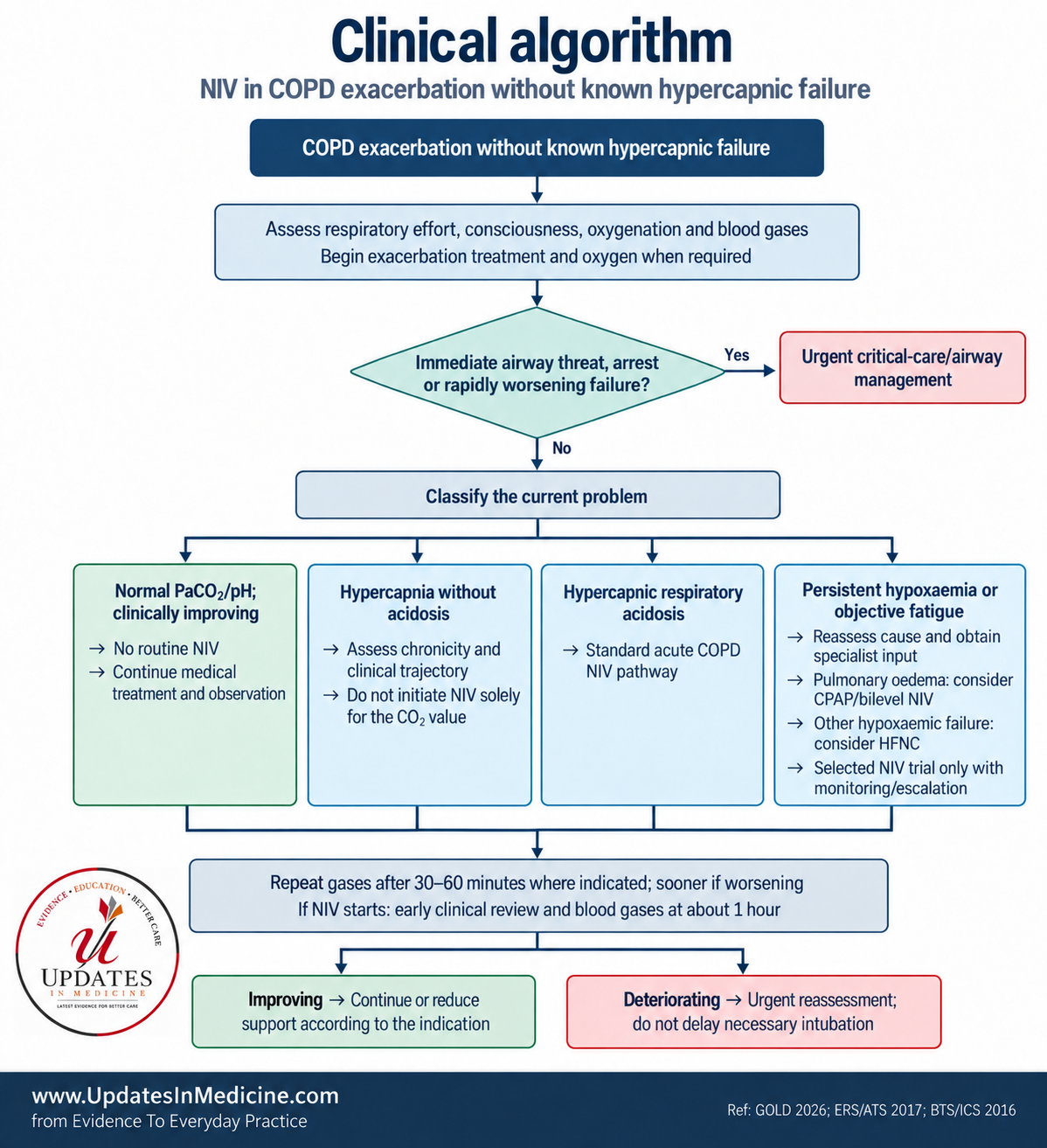
Algorithm synthesis: COPD NIV selection, hypoxaemic respiratory support, oxygen reassessment and acute NIV safety guidance. (Indian Journal of Critical Care Medicine )
Practice pitfalls
| Common error | Preferred approach |
|---|---|
| Assuming normal pH excludes hypercapnic respiratory failure | Interpret pH alongside PaCO₂, bicarbonate and previous gases. |
| Starting NIV simply because the patient is breathless | Establish a specific respiratory-support indication. |
| Applying evidence from non-acidotic hypercapnia to normocapnia | Check the actual study population. |
| Continuing NIV despite deterioration | Reassess promptly and follow the escalation plan. |
| Treating improved saturation as proof of recovery | Reassess respiratory effort, consciousness and ventilation. |
These distinctions address inappropriate patient selection and delayed recognition of treatment failure. (Indian Journal of Critical Care Medicine )
Remaining uncertainties
The main unanswered question is whether a reproducible subgroup with normal PaCO₂ but severe persistent respiratory effort benefits from early NIV. Appropriate selection criteria, treatment duration and patient-important benefits remain insufficiently established. (Indian Journal of Critical Care Medicine )
Non-acidotic hypercapnia also warrants further study. A 2026 observational cohort identified increased prognostic risk, but did not establish that earlier NIV improves outcomes. Its exploratory PaCO₂ risk threshold should not be converted into a treatment threshold. (Springer )
What to do on the next ward round
For every patient receiving NIV without respiratory acidosis, ask:
What is the indication? What objective benefit has occurred? What is the escalation or stopping plan?
The practical principle is to treat the physiological problem and its trajectory—not the COPD label or breathlessness alone.
Supporting literature review and evidence map
Clinical scope and source review
This review concerns adults with acute COPD exacerbations in emergency, ward and critical-care settings. Its primary question is whether NIV benefits patients without hypercapnia. Non-acidotic hypercapnia is considered separately. Long-term home NIV, post-extubation support and sleep-disordered breathing are outside scope.
The sources comprise official guideline documents, original publications, PubMed-indexed abstracts and the Cochrane review, with evidence considered through 20 September 2026. This is a focused clinical review, not a formal systematic review.
Guideline comparison
| Organisation and year | Relevant recommendation | Strength/certainty | Important qualification |
|---|---|---|---|
| ERS/ATS, 2017 | Against routine NIV in non-acidotic hypercapnia; supports NIV for acute respiratory acidosis. | Against: conditional, low certainty. For acidotic failure: strong, high certainty. | The negative recommendation is not specifically a trial-based recommendation for normocapnia. (American Thoracic Society ) |
| ISCCM, 2020 | Avoid routine NIV in normocapnic or mildly hypercapnic exacerbations without acidosis. | Grade 2B. | Most directly addresses the principal question. (Indian Journal of Critical Care Medicine ) |
| BTS/ICS, 2016 | Start NIV when pH <7.35 and PaCO₂ >6.5 kPa persist or develop despite optimal treatment. | Grade A. | Criteria address acute hypercapnic respiratory failure, not prophylactic NIV. (ResearchGate ) |
| GOLD, 2026 | Broader indications include severe dyspnoea with objective fatigue/increased effort, or persistent hypoxaemia despite oxygen. | No separate certainty grade for each indication. | Does not establish benefit from routine NIV in stable normocapnic exacerbations. |
| ERS HFNC guideline, 2022 | Suggests HFNC over conventional oxygen or NIV in acute hypoxaemic respiratory failure. | Conditional; moderate certainty versus conventional oxygen, very low versus NIV. | Applies to hypoxaemic respiratory failure, not every breathless patient with COPD. (ResearchGate ) |
Major supporting evidence
| Study | Design and population | Important result | Limitation and practice relevance |
|---|---|---|---|
| Osadnik et al., 2017 | Cochrane review: 17 trials, 1,264 patients with acute hypercapnic respiratory failure. | Mortality: RR 0.54, 95% CI 0.38–0.76. Intubation: RR 0.36, 95% CI 0.28–0.46. | Supports the established indication; not evidence for normocapnic exacerbations. Both outcomes were graded moderate certainty. (Cochrane ) |
| Keenan et al., 2005 | Randomised trial: 52 patients with milder exacerbations; NIV plus standard treatment versus standard treatment. | Some early dyspnoea improvement; no demonstrated improvement in major outcomes. Only 12/25 completed prescribed NIV. | Small study with poor tolerance; not a purely normocapnic population. (Sage Journals ) |
| Pastaka et al., 2007 | Randomised trial: 47 patients with chronic hypercapnia and pH ≥7.35; 42 analysed. | Hospital stay: 5.5 ±2.6 days with NIV versus 10.1 ±4.4 days with standard treatment. | Suggests benefit in selected compensated hypercapnia; cannot be generalised to normocapnia. (PubMed ) |
| Xia et al., 2022 | HFNC versus conventional oxygen; 337 randomised patients with mild hypercapnia and pH ≥7.35. | Intubation criteria met by 4/158 versus 1/172 evaluable patients; no demonstrated benefit. | Low event rate and inadequate power; neither an NIV trial nor a purely normocapnic population. (Springer ) |
| Sartori et al., 2026 | Retrospective cohort: 407 hospitalised exacerbations. | One-year mortality: 14% with normocapnia, 24% with non-acidotic hypercapnia and 25% with acidotic hypercapnia. | Prognostic association—not evidence that initiating NIV without acidosis improves survival. (Springer ) |
RR: risk ratio; CI: confidence interval.
Claim-level evidence map
| Clinical claim | Supporting source and location | Essential qualification |
|---|---|---|
| Avoid routine prophylactic NIV in uncomplicated normocapnic exacerbations. | ISCCM 2020, COPD recommendations, p. S63. | Grade 2B; does not prohibit individualised treatment for another indication. (Indian Journal of Critical Care Medicine ) |
| Persistent hypercapnic respiratory acidosis warrants the acute NIV pathway. | BTS/ICS 2016, recommendation 25. | After initial optimal treatment; immediate airway threats require escalation. (ResearchGate ) |
| Specify oxygen targets and repeat blood gases despite initially normal PaCO₂. | BTS oxygen guideline 2017, COPD management section and recommendation W5. | Reassessment depends on risk and clinical trajectory. |
| Objective fatigue may justify assessment for support before hypercapnia develops. | GOLD 2026, Figure 4.8. | Broader clinical indication; normocapnic patient-selection evidence remains limited. |
| NIV requires an escalation plan and early reassessment. | BTS NIV quality standards 2018, statements 5–6. | Developed principally for acute hypercapnic respiratory failure. (British Thoracic Society ) |
| Cardiogenic pulmonary oedema is a separate indication for positive-pressure support. | ERS/ATS 2017, Question 2a. | Strong recommendation, moderate certainty; does not extend to cardiogenic shock. (American Thoracic Society ) |
Evidence synthesis
The distinction is between avoiding routine NIV in non-acidotic COPD and providing respiratory support for a separate or evolving indication. Differences between guidelines partly reflect different populations and clinical questions; they should not be interpreted as either universal endorsement or an absolute prohibition. The algorithm above is a practical synthesis, not a validated normocapnic NIV protocol. (Indian Journal of Critical Care Medicine )
References
- Global Initiative for Chronic Obstructive Lung Disease. Global Strategy for Prevention, Diagnosis and Management of COPD: 2026 Report. GOLD; 2026. (GOLD )
- Rochwerg B, Brochard L, Elliott MW, et al. Official ERS/ATS clinical practice guidelines: noninvasive ventilation for acute respiratory failure. European Respiratory Journal. 2017;50:1602426. doi: 10.1183/13993003.02426-2016.
- Davidson AC, Banham S, Elliott M, et al. BTS/ICS guideline for the ventilatory management of acute hypercapnic respiratory failure in adults. Thorax. 2016;71(Suppl 2):ii1–ii35. doi: 10.1136/thoraxjnl-2015-208209.
- Chawla R, Dixit SB, Zirpe KG, et al. ISCCM Guidelines for the Use of Non-invasive Ventilation in Acute Respiratory Failure in Adult ICUs. Indian Journal of Critical Care Medicine. 2020;24(Suppl 1):S61–S81. doi: 10.5005/jp-journals-10071-G23186.
- O’Driscoll BR, Howard LS, Earis J, Mak V. BTS guideline for oxygen use in adults in healthcare and emergency settings. Thorax. 2017;72(Suppl 1):ii1–ii90. doi: 10.1136/thoraxjnl-2016-209729.
- Davies M, Allen M, Bentley A, et al. British Thoracic Society Quality Standards for acute non-invasive ventilation in adults. BMJ Open Respiratory Research. 2018;5:e000283. doi: 10.1136/bmjresp-2018-000283.
- Oczkowski S, Ergan B, Bos L, et al. ERS clinical practice guidelines: high-flow nasal cannula in acute respiratory failure. European Respiratory Journal. 2022;59:2101574. doi: 10.1183/13993003.01574-2021.
- Osadnik CR, Tee VS, Carson-Chahhoud KV, et al. Non-invasive ventilation for the management of acute hypercapnic respiratory failure due to exacerbation of chronic obstructive pulmonary disease. Cochrane Database of Systematic Reviews. 2017;7:CD004104. doi: 10.1002/14651858.CD004104.pub4.
- Keenan SP, Powers CE, McCormack DG. Noninvasive positive-pressure ventilation in patients with milder chronic obstructive pulmonary disease exacerbations: a randomized controlled trial. Respiratory Care. 2005;50:610–616. PMID: 15871754.
- Pastaka C, Kostikas K, Karetsi E, et al. Non-invasive ventilation in chronic hypercapnic COPD patients with exacerbation and a pH of 7.35 or higher. European Journal of Internal Medicine. 2007;18:524–530. doi: 10.1016/j.ejim.2006.12.012.
- Xia J, Gu S, Lei W, et al. High-flow nasal cannula versus conventional oxygen therapy in acute COPD exacerbation with mild hypercapnia: a multicenter randomized controlled trial. Critical Care. 2022;26:109. doi: 10.1186/s13054-022-03973-7.
- Sartori G, Fantin A, Sartori F, et al. Hypercapnia at admission, regardless of acidosis, may worsen the outcome of hospitalised patients with chronic obstructive pulmonary disease exacerbations. Internal and Emergency Medicine. 2026;21:1203–1213. doi: 10.1007/s11739-026-04279-0.
Evidence-integrity note
Direct evidence in genuinely normocapnic exacerbations remains limited. Some older trial details were assessed through original abstracts and guideline appraisals. GOLD 2026 recommendations were checked against its official Spanish-language full report; the ERS HFNC recommendations were checked against an author-deposited accepted manuscript. The listed 2017 BTS/ICS correction was not fully inspected.
The uploaded document supplied the editorial framework, rather than clinical evidence.